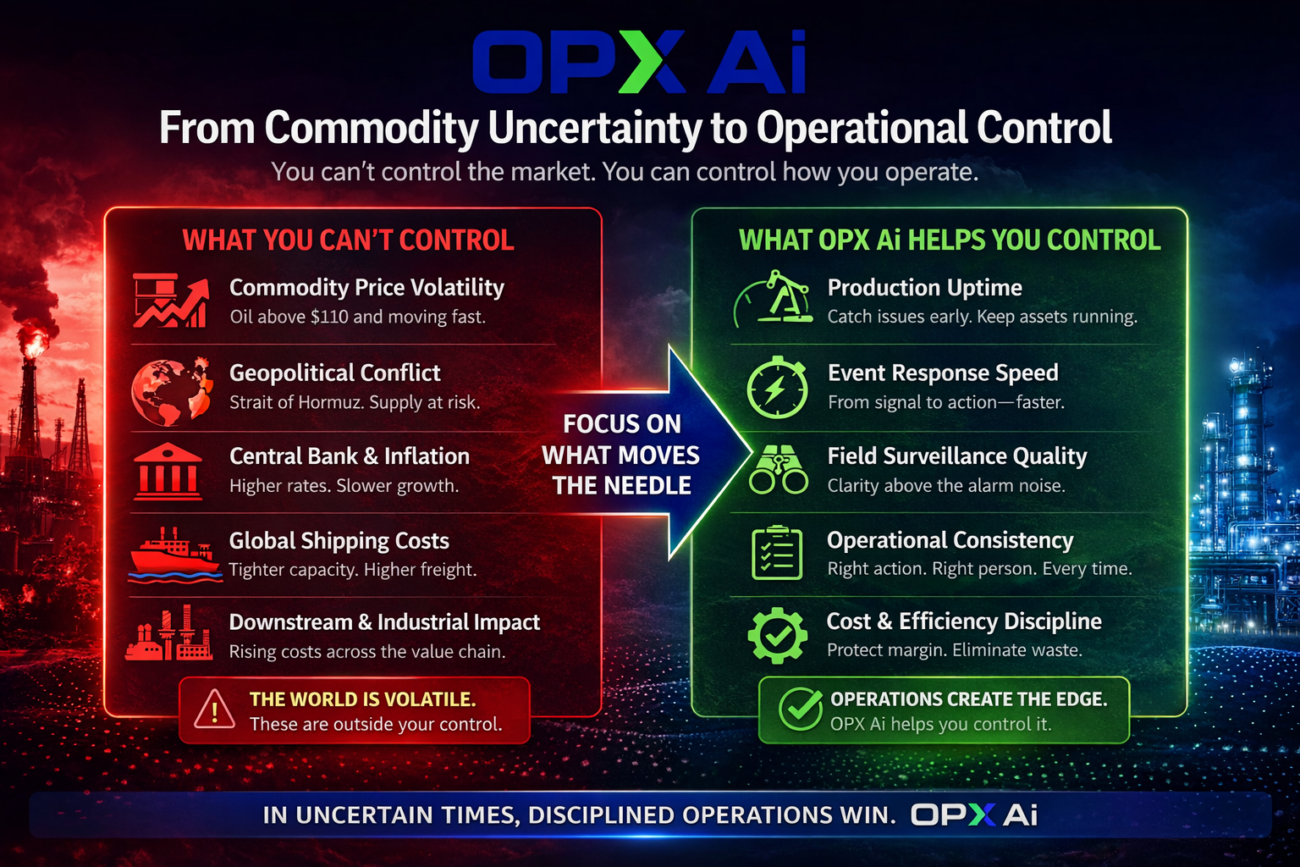
IRAN WAR: Volatility Is External. Execution Is Internal.
The Iran conflict has evolved into a classic “chokepoint shock” centered on the Strait of Hormuz: shipping through the strait has fallen sharply (the International Monetary Fund cites a ~90% drop), while oil and gas facilities and logistics networks have suffered damage or stoppages. The result is not just higher benchmarks, it’s a dislocation between “paper” prices (futures) and real barrels (physical differentials), plus a surge in shipping and insurance costs that compounds inflation pressure globally.
Spillovers are already visible beyond upstream. Jet fuel availability is tightening in Asia (closure-related disruptions are cutting off a meaningful share of seaborne jet fuel supply), petrochemicals are facing feedstock and import disruptions, and fertilizer prices have jumped as trade routes seize up. In parallel, central banks and official institutions are openly flagging the risk of higher inflation and weaker growth, including the European Central Bank and Federal Reserve Bank of New York.
In this environment, most leadership teams discover a hard truth: you cannot control geopolitics or commodity screens, but you can control decision latency, alarm overload, exception execution, and production deferment. Human-factors and Abnormal Situation Management research shows why this matters: operators hit cognitive limits quickly during alarm floods, and abnormal situations can translate into measurable capacity loss. OPX Ai’s “event → response” operational approach is designed for exactly this kind of volatility: compressing time-to-clarity and time-to-action when the market is least forgiving.
Volatility Is External. Execution Is Internal.
If you’re leading operations right now, you don’t need another debate about where Brent “should” trade.
You need a plan for how your organization performs when price, supply chains, and priorities move faster than your operating system can.
What the macro shock actually looks like on the ground
This is not a normal risk-premium cycle.
The war has turned the International Energy Agency’s most sensitive oil-security chokepoint into a real constraint. The IEA estimates roughly 20 million barrels per day of crude + products normally transit Hormuz, with limited bypass capacity relative to those flows, and notes that a closure would also strand a material share of global LNG exports. The U.S. Energy Information Administration similarly frames Hormuz as a critical chokepoint for a large portion of seaborne oil trade and LNG flows in recent years.
Markets are pricing that reality in three layers:
First, benchmarks are up and staying volatile. Reuters reports Brent around $109/bbl on April 7 and up over 50% from roughly $70 just before the conflict began (Feb. 28). In Europe and the Atlantic Basin, real barrels are repricing even harder: Reuters reports that North Sea Forties crude printed around $146/bbl, and notes that dated Brent (a physical benchmark) was trading materially above Brent futures—classic “prompt scarcity” behavior.
Second, shipping friction is compounding the price shock. War-risk premiums have surged “as much as 1,000%” in some cases, according to Reuters, with governments (e.g., India) exploring sovereign backstops to keep insurance available. This matters because even if the strait reopens, price normalization is not instantaneous: Reuters quotes the EIA warning that full restoration of flows could take months, and that uncertainty could keep prices above pre-conflict levels through year-end.
Third, the shock is already bleeding into FX and macro policy. Reuters reports physical premiums in Asia reaching up to $40/bbl over “paper” prices, with Morgan Stanley estimating Asia’s energy burden could rise markedly if elevated prices persist. The ECB explicitly links the war-driven energy shock to upward inflation revisions and weaker growth trajectories, including an estimate of reduced global GDP growth over the next two years. In the U.S., New York Fed President John Williams expects the energy shock to lift headline inflation (with a risk of exceeding 3% in the near term) and to weigh on growth.
Spillovers beyond oil and gas
An oil chokepoint shock is never “just oil.”
It is refined products, petrochemical feedstocks, fertilizers, logistics capacity, and downstream manufacturing margins—all at once. The IMF/IEA/World Bank joint statement explicitly highlights transmission through higher oil, gas, and fertilizer prices, and points to supply-chain impacts (including helium, phosphate, aluminum) and flight disruptions.
You can see that transmission in near-real-time:
- Jet fuel availability is tightening: Reuters reports that the Hormuz disruption has cut off nearly 21% of global seaborne jet fuel supply (shipping analytics from Kpler), prompting airlines to cut schedules, add refueling stops, and carry extra fuel.
- Petrochemicals are under strain: Reuters reports India temporarily removing import taxes on 40 petrochemical products to ease shortages and downstream cost pressure after emergency diversion of local chemicals toward LPG supply.
- Fertilizers are repricing: Reuters reports benchmark urea prices up roughly 70% since late February, as shipping constraints block a key trade route, with knock-on effects for planting decisions and food inflation risk.
This is why macro institutions keep emphasizing: even if hostilities stop, the aftershocks (logistics, inventories, insurance, re-routing capacity) don’t unwind on a convenient schedule.
What volatility exposes inside an operation
When price moves fast, weak operations don’t hide—they compound.
Four failure modes show up in almost every asset base under stress:
Alarm floods and “signal overload.” Human performance limits arrive quickly. ASM research used by ISA indicates operators can manage on the order of ~10 alarms per 10 minutesbefore performance degrades, and cites a practical “performance ceiling” on the order of ~49 seconds per alarm for executing expected response steps. Industry benchmarking shows why this becomes dangerous: average alarm rates can be ~29 alarms/hour across industries, and some systems can spike drastically higher during floods.
Decision latency. The Abnormal Situation Management consortium’s own field studies emphasize that people are not good at detecting problems in large bodies of data, and that stress amplifies inconsistency—exactly what happens during rapid transients and cascading upsets. In practice, “time-to-diagnosis” can be longer than the process can tolerate.
Missed production and avoidable deferment. ASM site studies have associated operations practices and abnormal situations with 3-8% of plant capacity effectively lost due to unexpected events (even when they don’t become “headline incidents”). During a price shock, that same percentage is suddenly worth far more per day.
Chemical / flow-assurance program instability. When monitoring is fragmented, chemical delivery can become inconsistent, especially with equipment issues like clogging in downhole chemical injection components. A 2024 flow assurance teardown study of chemical injection valves found clogging as a key failure driver and notes that interruptions and deposition risks can disrupt reliable chemical delivery. Separately, peer-reviewed literature links scaling to formation damage and reduced petroleum production if not correctly inhibited.
Why OPX Ai’s approach is built for commodity-price volatility
Here’s the key idea: you cannot out-predict geopolitics, but you can out-execute volatility.
OPX Ai is valuable in this period because it is designed around the operational layer most organizations still underbuild:
Signals → Events → Response
Not more dashboards. Not “AI” as a buzzword. An operating system that reduces cognitive load and makes response consistent when conditions shift.
Concretely, that maps to four capability blocks:
Event modeling (clarity above alarm noise).
Instead of asking operators to interpret dozens of tags and alarms, events group the operational truth: what changed, what it likely means, what should happen next. This is the practical antidote to alarm flooding limits documented in ISA/ASM research.
IOC-as-a-service (standardized, faster deployment).
In volatile cycles, time matters. “Build a custom digital center for two years” is the wrong tempo. The IEA has already signaled disruptions spreading across products and regions; you need improvements that land in weeks, not years.
Response orchestration (shortening decision latency).
When the operating model includes ownership, runbooks, escalation, and closure loops, you turn “someone should look at this” into “this is assigned, executed, and verified.” That directly targets the human/organizational contributors ASM highlights in abnormal situations.
Surveillance at scale (fewer misses, faster detection).
If one engineer can triage hundreds of wells/units because the system surfaces only true exceptions, you reduce the chance of missing early signs that become deferment later—especially when field crews, logistics, and supply chains are stressed.
Expected benefit ranges (realistic, assumption-based):
Exact results depend on baseline maturity, but using ISA/ASM benchmarking as guardrails, realistic near-term targets are:
- 30–60% reduction in “operator interruption load” (alarms/notifications requiring attention) by moving from flood-prone rates toward ISA/EEMUA-style manageable bands and by aggregating multiple signals into fewer actionable events.
- 15–40% reduction in response time for recurring high-frequency event types (because the workflow is pre-modeled and guided, rather than rediscovered each time). This range is an operational assumption aligned to removing “search + interpret” steps that dominate response under overload.
- 0.3–1.0% production retention (or more) in assets where abnormal situations and avoidable deferment are material, assuming you recover only a fraction of the ASM-observed 3–8% capacity loss band via earlier detection and higher-quality execution.
Even small percentages become strategic when Brent is >$100 and physical differentials are extreme: the marginal barrel is disproportionately valuable.
If your control room still feels reactive, or your operation is still translating alarms into meetings instead of actions. I’m happy to compare notes. No pitch. Just operating realities in a volatile market.

Operational memory for industrial operations
OPX AI connects system signals, operator context, engineering decisions, actions, and measured outcomes into an asset-specific operating history; so teams can use what the operation has already learned.
Start with one repeating operating problem
What does your team keep having to relearn?
Bring us one asset, workflow, recurring event or operating issue where context keeps getting lost between shifts, teams and systems. We will help determine whether a Memory Lane can turn that fragmented history into a repeatable operating advantage.
Decisions buried in shift logs, emails and spreadsheets
Troubleshooting repeated from scratch
Actions taken without the full operating history