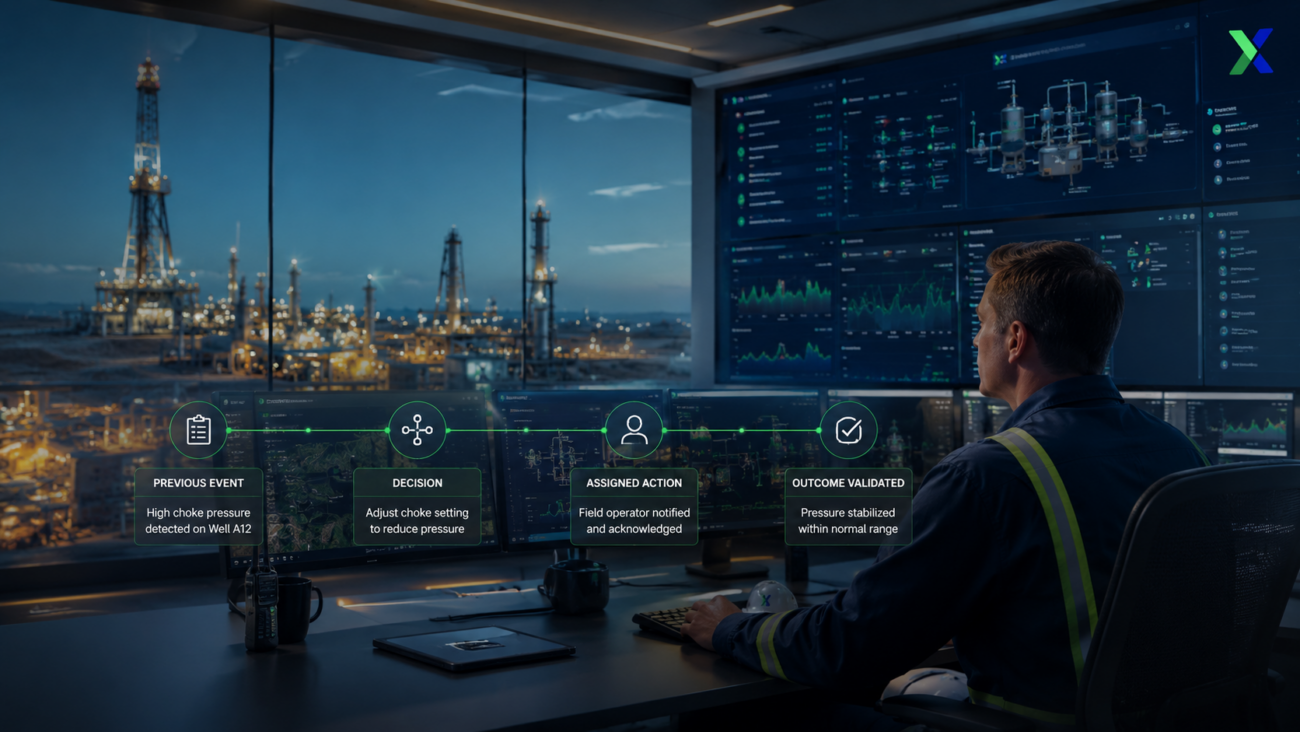
Control Rooms Were Built to Watch. Operations Need Them to Remember.
Oil and gas control rooms can see more of the operation than ever. But when the same event returns, teams still pull trends, call the field, search shift notes, and rebuild the operating story.
“Call Mark. He’ll remember.”
A compressor trips overnight.
The control room sees the alarm. The historian captures the pressure drop. The operator resets the unit and brings it back online.
By the morning meeting, the questions begin.
“What did nights see?”
“Why did they restart it?”
“Has this happened before?”
“Did the fix hold?”
“Who was on shift?”
“Call Mark. He’ll remember.”
The control room saw the event.
The operation did not retain the full story.

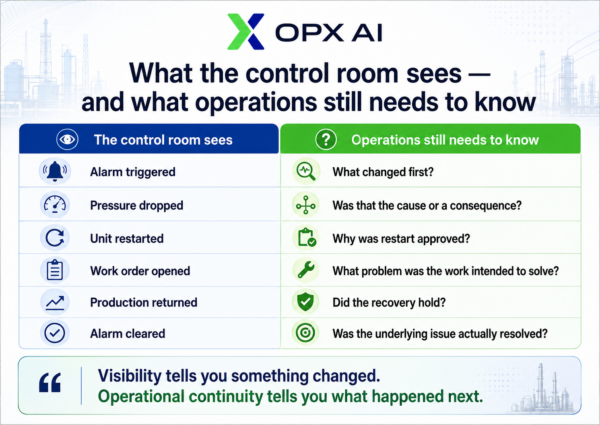
More screens did not solve the handover
Oil and gas companies have invested heavily in control rooms, integrated operations centres, SCADA, historians, alarm systems, dashboards, and remote surveillance.
Those systems matter.
They help teams oversee more assets, coordinate work across large areas, and respond to abnormal conditions faster.
But visibility is not the same as continuity.
A control room can tell you that a well tripped.
It may not tell you:
- What the field operator found
- Why the restart was approved
- What engineering believed was happening
- What had already been tried
- Whether the action solved the problem
- What the next shift should do differently
That context is usually scattered across shift notes, work orders, phone calls, emails, dashboards, and a few experienced people.
The systems hold pieces of the event.
The team still rebuilds the story.
The phone call is still the integration layer
This is what operators mean when they say:
“It’s in the system somewhere.”
The alarm is in SCADA.
The trend is in PI.
The site visit is in the shift log.
The repair is in the work order.
The vendor recommendation is buried in an email.
The reason for the decision may only exist in a conversation.
So the control-room operator starts calling around.
The field operator explains what they saw.
The engineer remembers a similar event.
The supervisor fills in why the decision was made.
Eventually, the team understands what happened.
Then the shift changes.
Much of that context disappears again.
The problem is not that the information does not exist. The problem is that no governed record connects it.
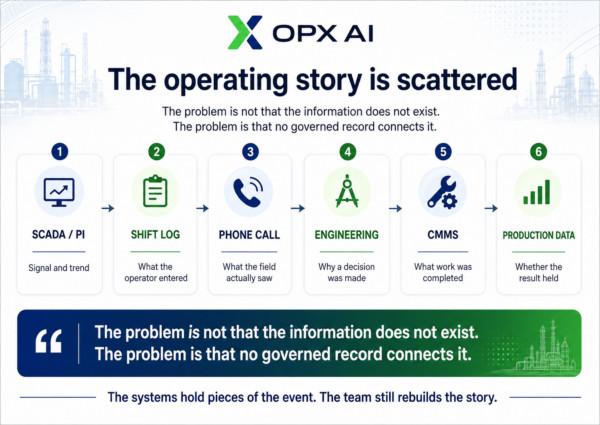
This is the central operational-memory gap: teams retain system records, but often lose the connected chain between state, observation, decision, action, outcome, and lesson.
When the control-room model becomes expensive
The people in the control room are not dead weight.
The operating model can be.
A control room becomes an expensive layer when it centralizes visibility but does not improve the organization’s ability to carry an event to closure.
The room may look modern.
The workflow still depends on:
- Pulling the same trends
- Calling the same experienced people
- Rebuilding the same timeline
- Repeating the same troubleshooting
- Passing unresolved issues into the next shift
That is not operating by exception.
That is centralized reconstruction.
Pull quote
The organization moved the screens into one room. It did not preserve what its people learned.
“Back online” does not mean “fixed”
A well returns to production.
A compressor restarts.
An alarm clears.
The event looks closed.
But was the underlying condition resolved?
Did the asset return to its previous stable state?
How long did the recovery hold?
Was the original hypothesis confirmed?
Did anyone measure the outcome?
Too often, the shift log says:
Unit reset and returned to service. Continue monitoring.
That records activity.
It does not confirm closure.
“Continue monitoring” also creates weak ownership. Everyone is watching, but no one is clearly responsible for deciding whether the action worked.
The event leaves the control room.
The problem stays with the asset.
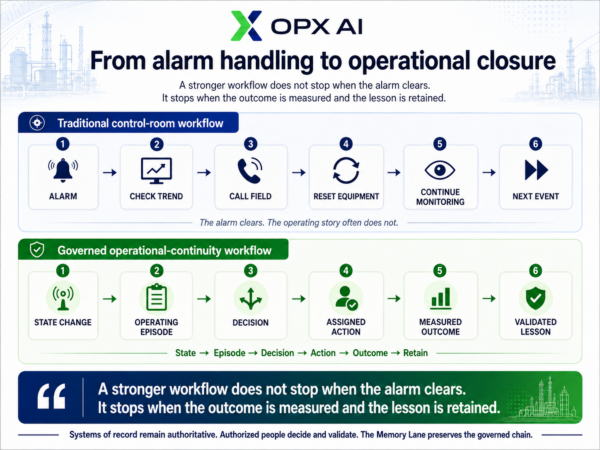
A stronger workflow does not stop when the alarm clears. It stops when the outcome is measured and the lesson is retained.
The current OPX AI product model formalizes this as:
State → Episode → Decision → Action → Outcome → Retain.
Systems of record remain authoritative, authorized people decide and validate, and the Memory Lane preserves the governed chain.
Where Buddy becomes more powerful than another dashboard
Buddy is not a simply a chatbot, it is the interface.
The useful part is what remains after the conversation ends.
Buddy can help the team surface:
- What changed
- What happened previously
- What the field observed
- What remains uncertain
- What decision was made
- Who owns the next action
- What outcome still requires validation
The Memory Lane underneath preserves that chain around the asset, workflow, event, sources, people, and time.
Buddy is the interface and action layer.
The governed operating memory is the durable asset.
A dashboard shows the current condition.
Operational memory helps explain how the asset got there, what was done before, and what should happen next.
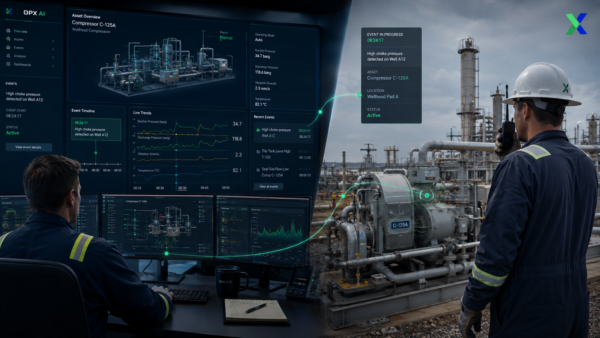
The field sees what the screens cannot. The control room sees what the field cannot. Operational memory connects both.
This does not remove the field operator
It makes field experience reusable.
The field operator often knows what the control room cannot see.
They know which transmitter is unreliable.
They know how the equipment sounded.
They know that the same repair failed last winter.
They know that a trend that looks normal across the fleet is unusual for this particular asset.
That judgment should not disappear into a phone call.
It should remain connected to the operating event so the next shift, engineer, supervisor, or vendor can use it.
Pull quote
This is not operator replacement. It is operator leverage.
A practical example
A well trips overnight.
The night shift gets it running again, but the well does not return to its previous stable rate.
What happens today
- The control room watches the rate
- The field checks the location again
- Engineering is asked to review the trend
- Someone searches previous shift notes
- A work order may be opened
- The morning shift inherits the issue
Each activity may be recorded separately.
The operating episode is not.
What should happen
The changed state is recorded.
A comparable prior event is retrieved.
The field operator adds what they observed.
Engineering records the working hypothesis.
The selected action receives an owner, expected result, and escalation condition.
Recovery is measured against a baseline.
The outcome is marked confirmed, rejected, or unresolved.
Only then is the lesson retained.
That is a much stronger definition of closure than:
“Well back online.”
The future control room will be judged by closure
The next generation of control rooms will not be defined by how many screens are on the wall.
They will be defined by whether they can answer, without calling around:
- What changed?
- Has this happened before?
- What did the field see?
- What decision was made?
- Who owns the action?
- Did the action work?
- What should be remembered next time?
That is more valuable than another dashboard.
It is more valuable than another alarm list.
And it is more valuable than an AI assistant that generates an answer but leaves no governed operating record behind.
Start with one recurring event
Do not redesign the whole control room.
Choose one event that repeatedly consumes operator, engineering, maintenance, or production time.
It may be:
- A recurring compressor trip
- A well that repeatedly fails to recover after restart
- An alarm with unclear ownership
- A degradation pattern interpreted differently across shifts
- A production interruption that triggers the same investigation each time
Then map the event from changed state to validated outcome.
Find where context disappears.
Find where ownership becomes unclear.
Find where the workflow stops before the result is measured.
That is where operational memory begins creating value.
The control room is not dead. The passive control room is.
A control room that only watches and escalates eventually becomes another expensive layer between the field and the decision.
A control room that remembers prior events, preserves field context, assigns actions, and validates outcomes becomes something far more powerful.
It becomes the place where the operation does not just see what happened.
It finishes what happened.

Operational memory for industrial operations
OPX AI connects system signals, operator context, engineering decisions, actions, and measured outcomes into an asset-specific operating history; so teams can use what the operation has already learned.
Start with one repeating operating problem
What does your team keep having to relearn?
Bring us one asset, workflow, recurring event or operating issue where context keeps getting lost between shifts, teams and systems. We will help determine whether a Memory Lane can turn that fragmented history into a repeatable operating advantage.
Decisions buried in shift logs, emails and spreadsheets
Troubleshooting repeated from scratch
Actions taken without the full operating history